







 Book an appointment
NỘI SOI TÌM NGUYÊN NHÂN NUỐT NGHẸN, PHÁT HIỆN UNG THƯ THỰC QUẢN GIAI ĐOẠN MUỘN
 Posted date: 31/01/2026
 Posted by: Nguyễn Kim Bình

Quick view of main content
Endoscopy Identifies Late-Stage Esophageal Cancer Following Dysphagia Symptoms
Detection of Suspected Esophageal Cancer Through Endoscopy
Multidisciplinary Assessment to Accurately Evaluate Disease Stage
Specialist’s Perspective
Medical Advice for the Public
Endoscopy Identifies Late-Stage Esophageal Cancer Following Dysphagia Symptoms
Dysphagia (difficulty swallowing) is a common symptom that may result from various conditions affecting the esophagus or the pharyngeal region. Common causes include gastroesophageal reflux disease (GERD), achalasia, esophageal strictures or obstruction, esophagitis, esophageal tumors, and certain neurological disorders such as multiple sclerosis. Notably, dysphagia is also one of the key warning signs of esophageal cancer.
In the early stages, patients may experience difficulty swallowing solid foods such as meat or fish. As the disease progresses, dysphagia often worsens and may occur even with liquid foods such as porridge or soup, significantly affecting daily life and nutritional intake.
Detection of Suspected Esophageal Cancer Through Endoscopy
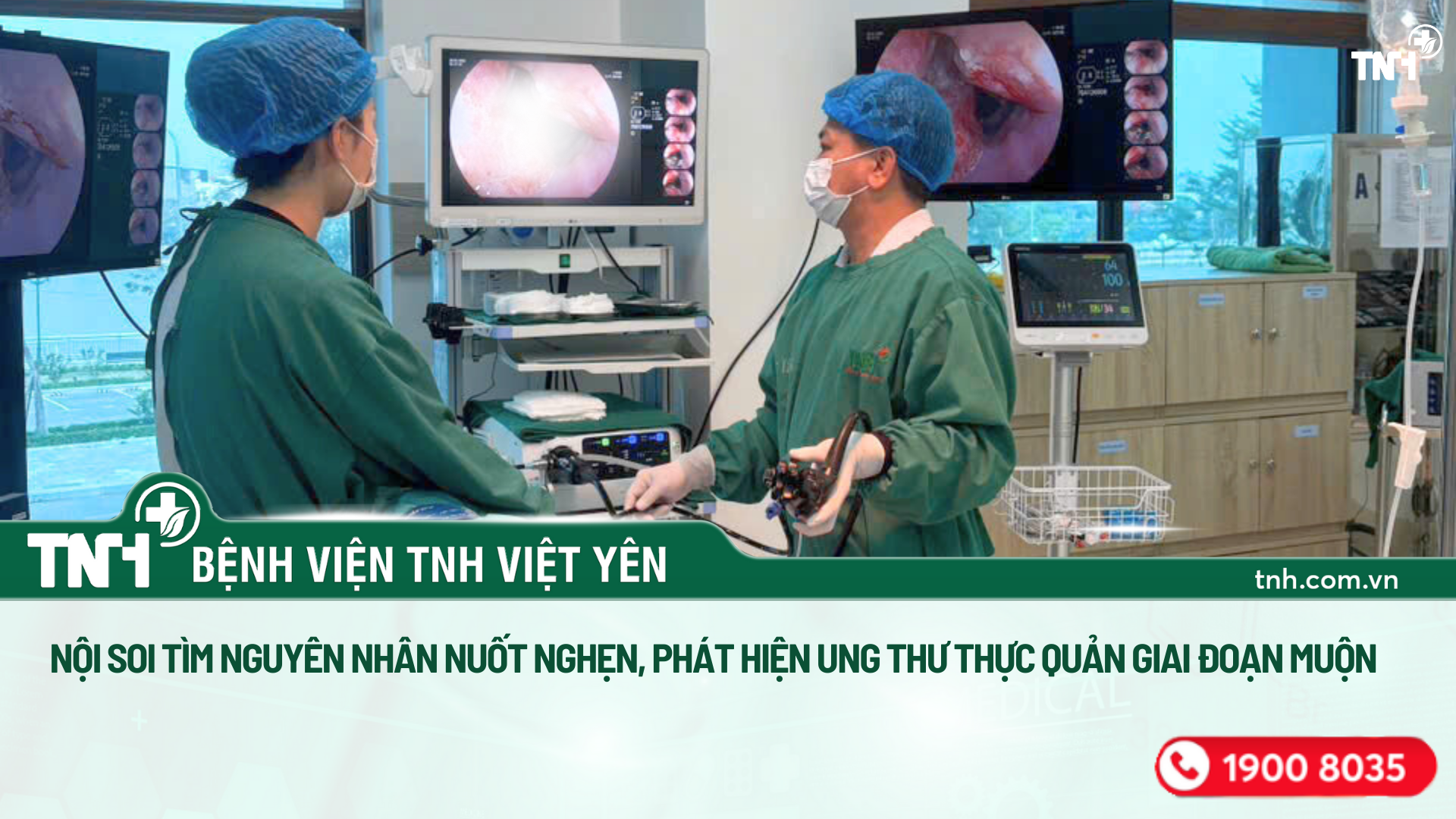
Recently, the Department of Functional Diagnostics at TNH Viet Yen Hospital received a 50-year-old male patient presenting with persistent dysphagia and a sensation of food sticking, accompanied by weight loss and prolonged difficulty eating.
Upper gastrointestinal endoscopy revealed a large ulcerative and infiltrative lesion with irregular margins. The surrounding mucosa was deformed and bled easily upon contact. The esophageal lumen was markedly narrowed, significantly obstructing the passage of food into the stomach—features characteristic of advanced malignant esophageal tumors.
Endoscopic findings indicated an invasive lesion highly suggestive of late-stage esophageal cancer. The endoscopy team performed multiple biopsies from different suspicious areas for histopathological examination to confirm the diagnosis.
Multidisciplinary Assessment to Accurately Evaluate Disease Stage
The procedure was conducted with direct professional support from Dr. Hoang Tri Tai, MD, a specialist in gastrointestinal endoscopy from Ho Chi Minh City. Through close collaboration between the visiting specialist and the endoscopy team at TNH Viet Yen Hospital, the examination enabled a comprehensive assessment of tumor extent, depth of invasion into the esophageal wall, and involvement of adjacent structures, allowing for accurate estimation of the disease stage.
Based on the collected data, the medical team conducted case discussions and provided individualized treatment recommendations tailored to the patient’s specific condition.
Specialist’s Perspective
According to Dr. Doan Manh Dung, MD, Head of the Department of Functional Diagnostics at TNH Viet Yen Hospital, esophageal cancer is a malignant disease of the upper gastrointestinal tract characterized by silent progression and minimal symptoms in the early stages. Consequently, most cases are diagnosed only when the disease has reached an advanced stage.
Common clinical manifestations include progressively worsening dysphagia, initially with solid foods and later involving liquids, reflecting gradual narrowing of the esophageal lumen due to tumor invasion. Patients may also experience retrosternal pain or pressure when swallowing, rapid weight loss, and prolonged fatigue resulting from impaired nutritional absorption.
In advanced stages, tumors often invade deeply through the esophageal wall, spread to surrounding tissues, or metastasize to lymph nodes and distant organs, making treatment more complex and significantly reducing survival outcomes. Therefore, early detection through endoscopy and histopathological biopsy plays a crucial role in improving treatment effectiveness and enhancing patients’ quality of life.
Medical Advice for the Public
Doctors recommend that individuals experiencing recurrent or progressively worsening dysphagia seek medical attention promptly for appropriate consultation, diagnosis, and timely intervention. If esophageal lesions are suspected, physicians will order necessary laboratory tests and imaging studies to determine the most effective treatment strategy.
TNH Viet Yen Hospital is proud to be one of the medical centers providing comprehensive diagnostic and treatment services for gastrointestinal diseases ranging from mild to severe. With support from experienced specialists from central-level hospitals and a modern medical equipment system, the hospital is well-equipped to meet patients’ diagnostic and treatment needs.
For consultation and appointment scheduling, patients may contact the hotline 1900 8035 for assistance.