







 Book an appointment
HỆ THỐNG NỘI SOI TIÊU HÓA CV 1500 (EVIS X1) TÍCH HỢP AI - NÂNG CAO HIỆU QUẢ TẦM SOÁT UNG THƯ TIÊU HÓA SỚM
 Posted date: 02/03/2026
 Posted by: Nguyễn Kim Bình

Quick view of main content
Clinical Applications of the CV 1500 (EVIS X1) System
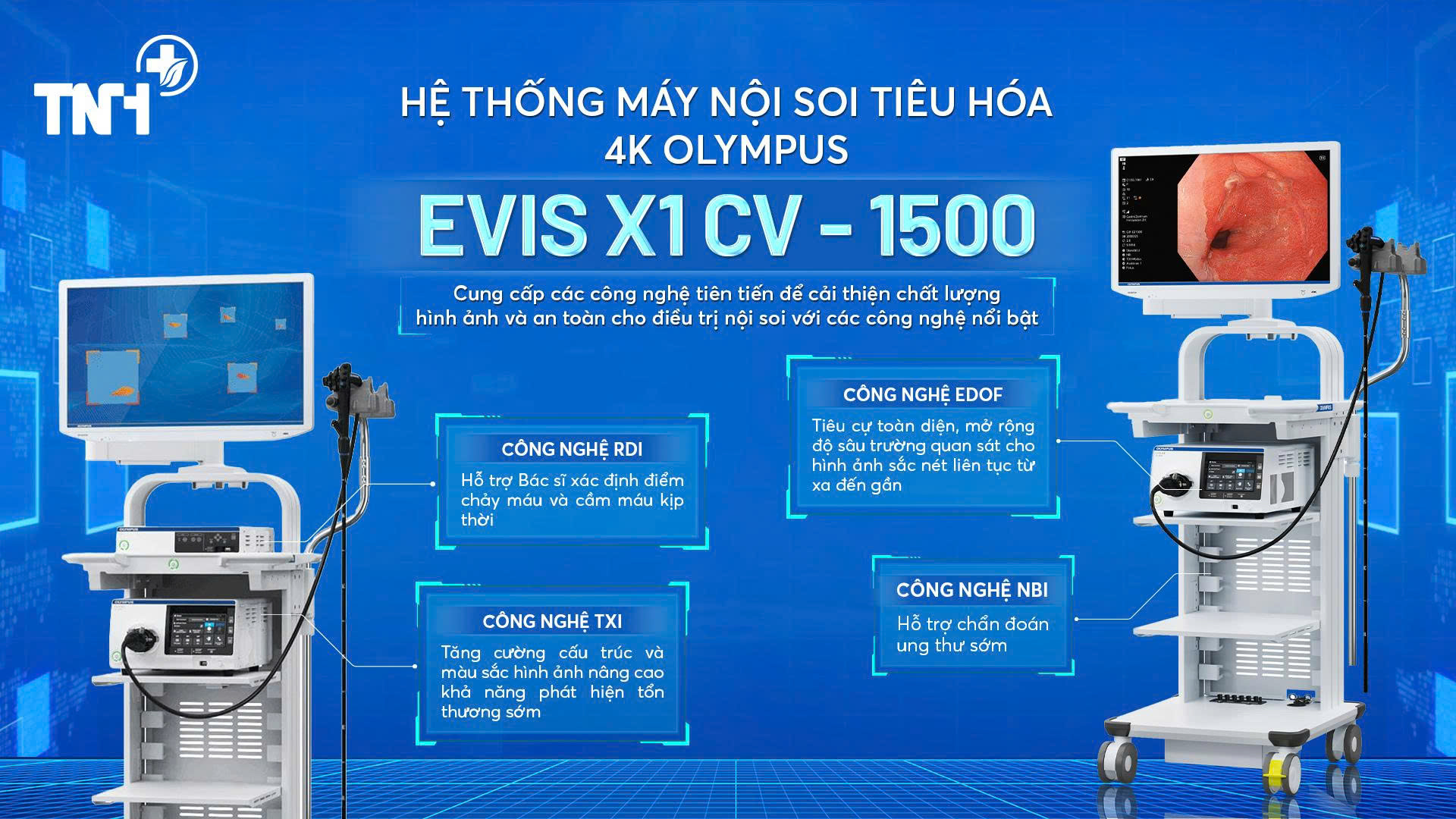
CV 1500 (EVIS X1) Gastrointestinal Endoscopy System Integrated with AI
Enhancing the Effectiveness of Early Gastrointestinal Cancer Screening
The CV 1500 (EVIS X1) gastrointestinal endoscopy system by Olympus Corporation is a next-generation endoscopy platform integrated with artificial intelligence (AI), representing a significant advancement in the diagnosis and intervention of gastrointestinal diseases. The system has recently been installed at the Functional Exploration Department of Bệnh viện Quốc tế Thái Nguyên.
Developed based on the latest achievements in optical science, digital image processing, and artificial intelligence, EVIS X1 not only enhances image quality but also strongly supports clinical decision-making, particularly in the early detection of gastrointestinal cancers and precancerous lesions.
At the core of the system is the CV 1500 image processor, capable of delivering 4K Ultra HD display with sharp images, high contrast, and true-to-life colors. This enables the clear visualization of even the smallest changes on the mucosal surface, vascular patterns, or tissue structures, thereby reducing the risk of missed lesions during endoscopy.
EVIS X1 integrates multiple advanced imaging technologies. Notably, TXI (Texture and Color Enhancement Imaging) is a next-generation white-light technology that enhances tissue structure and color, highlighting suspicious areas that conventional white-light endoscopy may overlook. NBI (Narrow Band Imaging) uses narrow-band light to clearly visualize microvascular networks and mucosal surfaces, supporting optical diagnosis and differentiation between benign and malignant lesions. Additionally, RDI (Red Dichromatic Imaging) enhances the detection of deep blood vessels and bleeding points, particularly useful in interventional endoscopy. EDOF (Extended Depth of Field) expands the depth of field, maintaining consistently sharp images from near to far, even during magnification.
A standout advantage of EVIS X1 is its integration of artificial intelligence (AI), particularly through applications such as CADe (Computer-Aided Detection). AI functions as a “digital assistant,” providing real-time alerts for abnormal areas, improving polyp and small lesion detection rates while reducing reliance on operator subjectivity.
Clinical Applications of the CV 1500 (EVIS X1) System
In clinical practice, the CV 1500 (EVIS X1) system is widely used for screening, diagnosis, and treatment of gastrointestinal diseases from the esophagus and stomach to the colon and rectum. With high-resolution 4K imaging combined with enhanced observation modes such as TXI and NBI, the system enables the detection of very small lesions measuring only a few millimeters, including polyps, flat lesions, precancerous lesions, and early-stage cancers—conditions that are often missed with conventional endoscopy.
In interventional endoscopy, RDI technology assists physicians in quickly and accurately identifying bleeding sites, thereby improving the effectiveness and safety of procedures such as hemostasis, polypectomy, endoscopic mucosal resection, and management of gastrointestinal bleeding. Meanwhile, EDOF ensures clear visualization across the entire field of view, supporting precise manipulation throughout the intervention process.
Importantly, the integration of AI in EVIS X1 allows real-time image analysis and alerts for suspicious areas, helping standardize endoscopic quality, reduce dependence on individual experience, and enhance lesion detection rates. Thanks to these advantages, the CV 1500 system plays a crucial role in improving the effectiveness of early gastrointestinal cancer screening and patient prognosis.
With its harmonious combination of ultra-high-resolution imaging, advanced processing technologies, and AI integration, the CV 1500 (EVIS X1) gastrointestinal endoscopy system not only elevates endoscopic standards at the TNH Hospital System but also opens a more modern, safe, and effective approach to the diagnosis and treatment of digestive diseases. It is considered a key technological foundation contributing to improved prognosis and quality of life in the era of precision medicine.