







 Book an appointment
ENDOSCOPIC SUBMUCOSAL DISSECTION (ESD): A MINIMALLY INVASIVE TREATMENT FOR EARLY-STAGE GASTROINTESTINAL CANCER WITH MAXIMUM ORGAN PRESERVATION
 Posted date: 13/10/2026
 Posted by: Nông Đức Thắng


Quick view of main content
ESD – An Advanced Endoscopic Technique for Treating Gastrointestinal Lesions
When Is Endoscopic Submucosal Dissection Indicated?
Key Advantages of Endoscopic Submucosal Dissection
1. Minimally Invasive Treatment Without Abdominal Incisions
2. Complete Removal of Lesions in a Single Piece
3. Maximum Preservation of Digestive Organ Structure and Function
4. Management of Complex Gastrointestinal Lesions
5. Potential Reduction in the Need for Repeated Interventions
Early Detection of Gastrointestinal Cancer – A Key Factor in Increasing Opportunities for Organ-Preserving Treatment
TNH Viet Yen Hospital Focuses on Advancing Specialized Gastrointestinal Endoscopy Techniques
CONTACT INFORMATION
TNH HOSPITAL SYSTEM
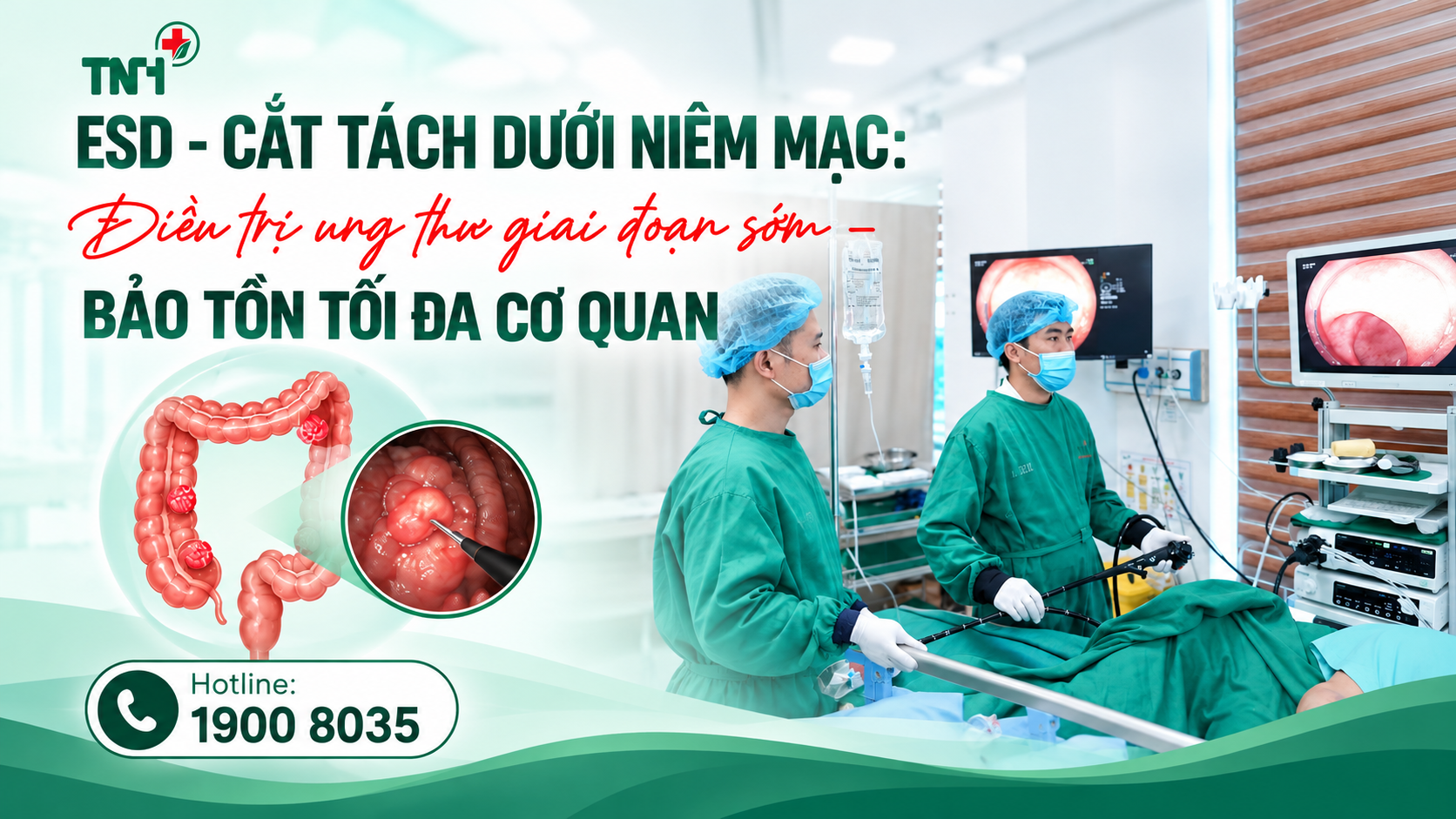
Gastrointestinal cancers, particularly gastric and colorectal cancers, can sometimes be treated using advanced endoscopic techniques when detected at an early stage, potentially avoiding surgery to remove part or all of the affected organ. Among these techniques, Endoscopic Submucosal Dissection (ESD) is a minimally invasive treatment that enables the removal of selected lesions while preserving the structure and function of the digestive organs, thereby contributing to improved quality of life for patients.
ESD – An Advanced Endoscopic Technique for Treating Gastrointestinal Lesions
Endoscopic Submucosal Dissection (ESD) is an advanced endoscopic procedure that uses specialized instruments and electrosurgical knives to dissect and remove lesions involving the mucosal and superficial submucosal layers of the gastrointestinal tract.
One of the key advantages of ESD is its ability to remove an entire lesion in a single piece, known as en bloc resection, even when the lesion is relatively large or extends across a broad area of the mucosal surface, provided that it meets the appropriate treatment criteria.
Compared with conventional polypectomy or certain endoscopic mucosal resection techniques, ESD allows physicians to control the resection margins and depth of dissection more precisely. This facilitates complete lesion removal and provides an intact specimen for accurate histopathological examination.
Importantly, for selected cases of very early-stage gastrointestinal cancer with a negligible risk of lymph node metastasis based on clinical assessment, ESD may offer an effective treatment option without the need for surgical removal of the affected organ.
When Is Endoscopic Submucosal Dissection Indicated?
ESD is used to treat certain precancerous lesions and early-stage gastrointestinal cancers, particularly those affecting the stomach and colorectum.
Doctors may consider ESD in the following cases:
- Very early-stage gastric cancer: Localized lesions that meet specific endoscopic treatment criteria regarding histological characteristics, size, and depth of invasion.
- Early-stage colorectal cancer: Lesions assessed as having superficial invasion and considered suitable for endoscopic resection.
- Large polyps and adenomatous lesions: Lesions that are difficult to remove completely using conventional polypectomy techniques.
- Laterally spreading lesions: Extensive or complex lesions involving the mucosal surface that require advanced dissection techniques to achieve complete removal.
- Lesions requiring accurate histopathological assessment: Cases in which en bloc resection is necessary to evaluate resection margins, invasion depth, and other risk factors, helping determine whether additional treatment is required.
The decision to perform ESD is not based solely on lesion size. Other important factors include lesion location, morphology, histological characteristics, depth of invasion, and the patient's overall health condition.
Before the procedure, physicians must carefully assess the lesion and evaluate potential risks to determine whether ESD is the most appropriate treatment option.
Key Advantages of Endoscopic Submucosal Dissection
Advances in ESD have expanded treatment options for patients with precancerous lesions and early-stage gastrointestinal cancers.
The main benefits of this technique include:
1. Minimally Invasive Treatment Without Abdominal Incisions
ESD is performed through the gastrointestinal tract using an endoscope, without the need for abdominal incisions in suitable cases.
This approach may help patients avoid some of the physical effects associated with open surgery or surgical removal of digestive organs.
2. Complete Removal of Lesions in a Single Piece
ESD enables en bloc removal of many large or extensive lesions, reducing the need for piecemeal resection.
This is particularly important for histopathological assessment, allowing physicians to evaluate the depth of invasion, resection margins, and other pathological risk factors more accurately.
3. Maximum Preservation of Digestive Organ Structure and Function
For patients who meet the criteria for endoscopic treatment, ESD may allow lesion removal without requiring partial or complete surgical removal of the stomach or sections of the colorectum.
Preserving the affected organ helps maintain natural digestive function and may reduce the long-term impact of treatment on patients' daily lives.
4. Management of Complex Gastrointestinal Lesions
ESD can be used for certain large, extensive, or morphologically complex lesions that may be difficult to remove completely using conventional polypectomy techniques.
5. Potential Reduction in the Need for Repeated Interventions
When appropriately indicated and successfully performed, en bloc resection may reduce the risk of residual abnormal tissue compared with piecemeal removal, potentially limiting the need for additional procedures at the same site.
However, ESD is a technically demanding procedure that requires experienced endoscopists and appropriate medical equipment. Potential complications include bleeding, gastrointestinal perforation, and other procedure-related adverse events.
Furthermore, histopathological findings after ESD may reveal risk factors that require additional surgery or other treatments.
Therefore, patients must undergo appropriate post-procedure monitoring and follow their physicians' recommendations.
Early Detection of Gastrointestinal Cancer – A Key Factor in Increasing Opportunities for Organ-Preserving Treatment
The effectiveness and suitability of minimally invasive treatments such as ESD depend significantly on how early the disease is detected and the characteristics of the lesion.
In the early stages, gastric and colorectal cancers may cause no noticeable symptoms or only nonspecific signs such as mild abdominal discomfort, digestive disturbances, bloating, or changes in bowel habits.
Therefore, proactive medical examinations and gastrointestinal cancer screening based on age, individual risk factors, and medical recommendations play an important role in detecting abnormalities at an early stage.
Gastrointestinal endoscopy allows physicians to directly examine the digestive tract lining, identify suspicious lesions, and perform biopsies when necessary.
These findings provide an essential basis for determining the most appropriate treatment approach, including whether ESD may be suitable.
The earlier gastrointestinal cancer is detected, the greater the opportunity for patients to access organ-preserving, minimally invasive treatment options and maintain a better quality of life.
TNH Viet Yen Hospital Focuses on Advancing Specialized Gastrointestinal Endoscopy Techniques
With a commitment to improving healthcare quality, the Department of Functional Diagnostics at TNH Viet Yen Hospital places strong emphasis on updating professional knowledge and advancing its understanding of modern gastrointestinal endoscopy techniques to enhance the diagnosis and treatment of digestive disorders.
Among these advances, Endoscopic Submucosal Dissection (ESD) represents an important specialized intervention for selected precancerous lesions and early-stage gastrointestinal cancers, expanding opportunities for organ-preserving treatment in appropriately selected patients.
Proactive screening, early detection, and appropriate treatment selection are essential factors in improving treatment outcomes for gastrointestinal cancer.
Individuals experiencing unusual digestive symptoms or belonging to high-risk groups are encouraged to seek medical consultation for appropriate examinations, risk assessment, and personalized recommendations.
CONTACT INFORMATION
TNH HOSPITAL GROUP JOINT STOCK COMPANY
Hotline: 1900 8035
Website: https://tnh.com.vn
TNH HOSPITAL SYSTEM
- TNH Viet Yen Hospital: Nguyen The Nho Street, Viet Yen Ward, Bac Ninh, Vietnam.
- Thai Nguyen International Hospital: No. 328 Luong Ngoc Quyen Street, Phan Dinh Phung Ward, Thai Nguyen, Vietnam.
- TNH Pho Yen Hospital: Tran Nguyen Han Street, Truong Thinh Residential Group, Van Xuan Ward, Thai Nguyen, Vietnam.
- TNH Lang Son Hospital: Block 10, Nhi Thanh Street, Tam Thanh Ward, Lang Son, Vietnam.